In Ancient Athens, ostracism ranked among the harshest punishments imaginable. Exclusion meant the loss of influence, voice, and belonging. As for today, many of us dream of a hermit-like life in the mountains, kilometers from the nearest human being – yet our professional lives remain deeply dependent on collaboration.
Workplace collaboration statistics consistently show the same pattern: yes, we can do great work individually. Freelancers turn ideas into reality, specialists deliver in focused solitude, and deep work still matters.
But even the most independent among us crave dialogue at some point: a quick brainstorm, a fresh perspective, or just a small “ding” from the outside world that nudges our thinking in a new direction. In office environments, this need becomes even more obvious – it’s almost in the air.
The pandemic pushed us into separation, and some of that shock will stay with us for a long time. But as we move toward 2026, corporate life is clearly pulling in the opposite direction. Organizations are nudging people to reconnect, collaborate in workplaces more intentionally, and yes, sometimes leave their home lairs to show up in offices again.
Not out of nostalgia, but because coordination, idea-generation, and resilience are simply harder to sustain alone, especially when meetings pile up and deadlines creep closer.
The question is no longer whether workplace collaboration matters – it’s how well it is designed, supported, and led.
Key workplace collaboration statistics for 2026
Workplace collaboration in 2026 is being reshaped by hybrid work, digital tools, and growing coordination complexity. The numbers below show not just how people collaborate today, but where the friction points really are.
The collaboration landscape
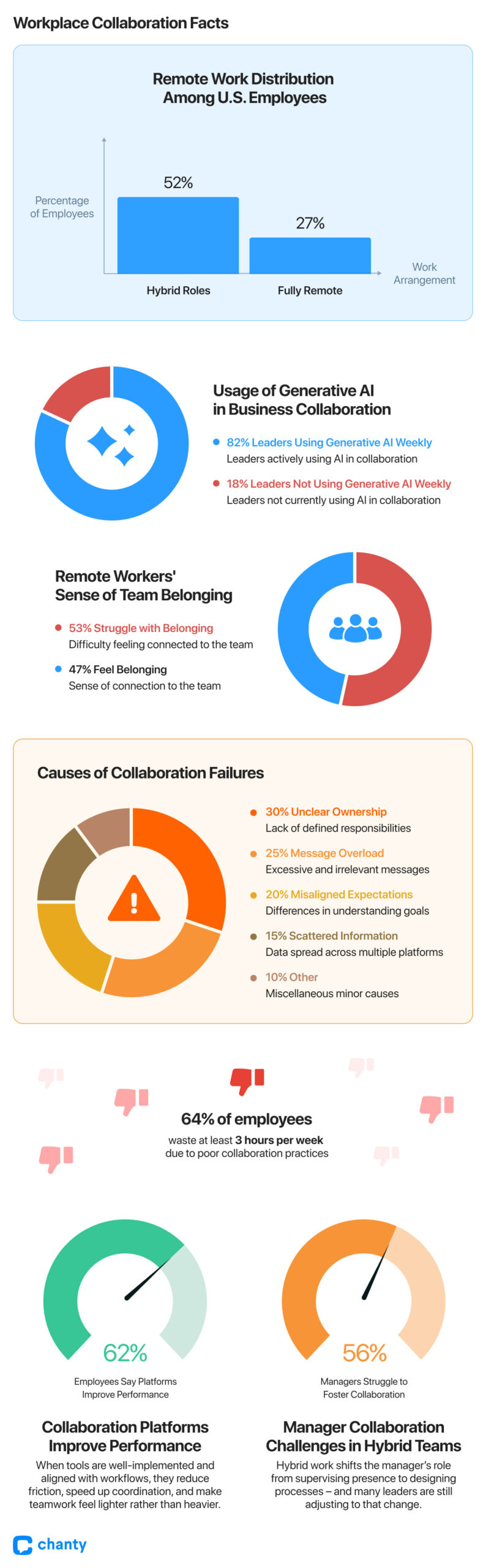
- 79% of remote-capable U.S. employees now work outside a traditional office at least part of the time
This includes 52% in hybrid roles and 27% fully remote. Collaboration is no longer designed around a shared physical space – it’s increasingly distributed, asynchronous, and tool-dependent. - 53% of remote workers say it’s harder to feel like part of a team
Flexibility has grown, but belonging hasn’t always followed. Distance still weakens informal connection, shared context, and spontaneous collaboration. - 82% of business leaders see 2025–2026 as a turning point for AI-powered collaboration
Leaders expect AI to actively shape how teams communicate, coordinate, summarize work, and make decisions – not just support them in the background. - 85% of collaboration failures are caused by poor communication management
The problem isn’t a lack of tools or effort – it’s unclear ownership, message overload, misaligned expectations, and information scattered across channels. - 62% of employees say collaboration platforms improve their performance
When tools are well-implemented and aligned with workflows, they reduce friction, speed up coordination, and make teamwork feel lighter rather than heavier. - 56% of managers struggle to foster collaboration in hybrid teams
Hybrid work shifts the manager’s role from supervising presence to designing processes – and many leaders are still adjusting to that change. - 64% of employees waste at least 3 hours per week due to poor collaboration practices
Inefficient meetings, duplicated work, unclear communication, and constant interruptions quietly drain productivity – often without being formally tracked.
What is the real value of collaboration in the workplace?
Collaboration is a survival mechanism as old as humanity itself. Across centuries, people have progressed by uniting around shared goals, combining different talents, perspectives, and ways of thinking. In the workplace, the same rule applies: ideas gain momentum only when they move between people.
A broken collaboration chain leaves no space for ideas to travel. Even the brightest insight can be lost when it remains inside a single mind. Shared effort is not just convenient – it is how ideas survive, grow, and gain a real chance to exist in the real world.
Collaboration as a multiplier
- 73% of employees report improved performance when engaged in collaborative work.
- 60% say collaboration boosts innovation, showing measurable creative gains.
- 17% of remote workers report struggling with collaboration and communication.
Collaboration amplifies results only when structured intentionally: clarifying ownership, reducing rework, and supporting decisions.
Why collaboration fails: communication, silos, and leadership gaps
Collaboration is meant to reduce effort, speed up problem-solving, and prevent individuals from carrying work alone. Earlier, we described its value as a catalyst for knowledge sharing and better decisions.
Yet for many teams today, collaboration feels increasingly exhausting. Endless meetings, delayed responses across time zones, constant follow-ups, and an expanding stack of tools leave employees overstimulated and mentally drained.
What was designed to help often becomes another layer of work.
This creates a growing paradox: teams want less constant collaboration, but still need fast, meaningful collaboration when problems arise. People want the ability to reach out for help, align quickly, and move forward – without getting lost in tools, policies, and approval chains.
The data points to structural misalignment, not lack of effort.
Key statistics behind collaboration failure
- ~67% of collaboration failures are caused by organizational silos (Harvard Business Review Analytics Services)
- 28% of missed deadlines are caused by miscommunication
- 41% of employees report difficulty collaborating across departments
- 80% experience stress due to unclear or conflicting instructions
- Over 50% lack visibility into other teams’ goals and priorities
Collaboration fails when alignment is assumed instead of designed, when teams lack shared priorities, clarity around roles and decision ownership, or when decision-making is siloed.
The hidden cost of poor collaboration
Collaboration drag is real: coordination consumes more energy than execution.
- 20% of employees lose up to six hours weekly, equivalent to nearly one full workday per month.
- 84% of marketers report frustration from excessive meetings, redundant feedback, and unclear roles
Why this matters
These lost hours don’t come from disengagement or lack of effort. They come from structural issues:
- overlapping communication channels
- too many stakeholders without clear decision rights
- meetings that exist to compensate for unclear processes
As work becomes more distributed, this drag intensifies. Microsoft’s 2025 workplace data shows that nearly 30% of meetings now include participants across multiple time zones, while meetings held after 8 p.m. have increased by 16% year over year. This signals the rise of the so-called infinite workday, where collaboration spills into personal time without delivering clearer outcomes.
Collaboration has not failed because people resist teamwork. It fails because poorly designed systems force employees to coordinate endlessly without enabling better decisions.
Teamwork vs individual work: The workplace “to be or not to be”
“Teamwork makes the dream work.”
It’s one of those phrases that sounds undeniably true – until you’ve been trapped in a meeting that should have been an email, with twelve people discussing something one person could have finished before lunch.
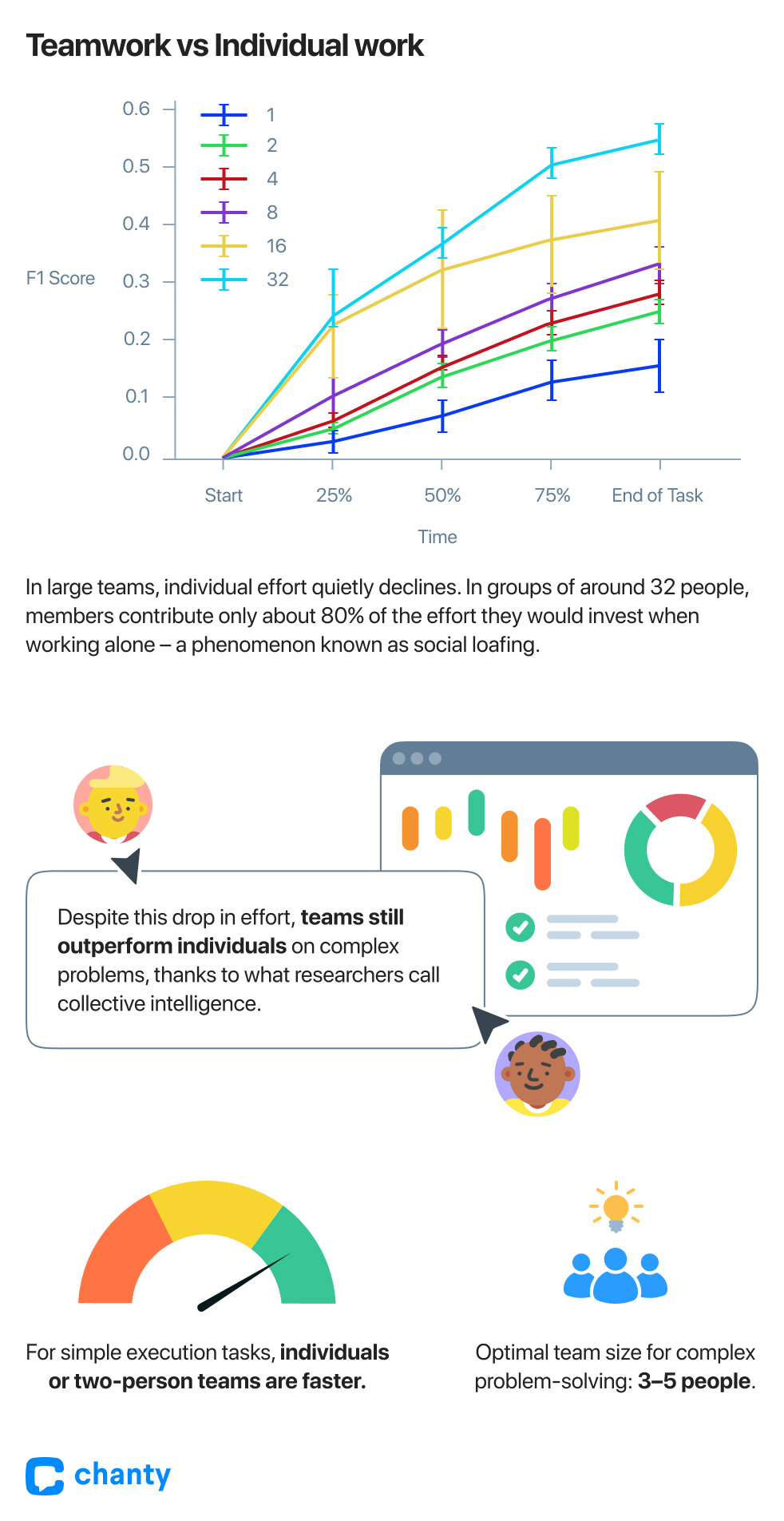
And yet, teamwork really can move mountains. Or at least stars. When people with different skills, temperaments, and ways of thinking come together around a complex problem, the results can be remarkable. Research shows that teams outperform individuals on complex tasks, even though – and this is the first plot twist – each person inside the team often works less hard than they would alone.
The teamwork paradox, in numbers
- In large teams, individual effort quietly declines. In groups of around 32 people, members contribute only about 80% of the effort they would invest when working alone – a phenomenon known as social loafing.
- Despite this drop in effort, teams still outperform individuals on complex problems, thanks to what researchers call collective intelligence.
- Optimal team size for complex problem-solving: 3–5 people.
- For simple execution tasks, individuals or two-person teams are faster.
- Sometimes, the fastest way forward is letting one capable person close the door and focus.
And yet, almost 90% of workers, according to a study by Statista, report that teamwork is important or very important for their job satisfaction – whether it’s within departments or across business units.
Even good teams need breathing room
Productivity isn’t the only measure that matters. Humans are social – but not endlessly social.
- Employees who work side-by-side with colleagues less than 50% of the time are twice as likely to report a sustainable work-life balance.
- When collaboration crosses that threshold, satisfaction begins to decline – even when people genuinely like their coworkers.
Translation: loving your team doesn’t mean wanting them in your mental space all day.
Different people, different collaboration sweet spots
Every workplace has its cast of characters.
- The brilliant specialist – focused, precise, slightly hermit-like – who does their best work alone. Put them into constant group discussion, and their spark dims.
- The social butterfly: energising, idea-sprinkling, morale-lifting. She shines brightest when others believe in her – a little like Tinkerbell, who famously weakens without applause.
The data support this human intuition:
- Research using the Big Five personality model shows that teamwork effectiveness follows an inverted U-shape.
- Moderate levels of extraversion and conscientiousness lead to the strongest contributions.
- Extremely high or low levels reduce effectiveness
- Introverts often contribute best after individual reflection or written preparation.
- Extraverts tend to thrive in verbal, synchronous collaboration.
Neither style is superior. They’re different tools for different moments.
Stanford research further shows that employees who prefer collaborative working:
- Can focus on tasks 64% longer than those who don’t,
- Experience less fatigue,
- Are more engaged, and
- Typically deliver more successful outcomes.
Only about 20% of executives believe their teams are truly high-performing. Not because teamwork is broken – but because it’s often applied as a default instead of a design choice.
The real answer to teamwork vs individual work
The smartest workplaces don’t choose sides.
- Individual work creates depth, focus, and original thinking.
- Teamwork refines ideas, fills blind spots, and solves complex problems.
- The strongest results come from solo thinking followed by group synthesis.
The best ideas rarely come from isolation alone or collaboration alone. They’re born in quiet moments of individual thinking – and sharpened when shared. In that sense, teamwork and solo work aren’t rivals. They’re partners. And when they’re balanced well, the drama fades, the noise drops, and the work finally starts to feel… human.
Remote and hybrid work: collaboration has shifted, not disappeared
The rise of remote and hybrid work has fundamentally changed collaboration in the workplace – but not in the way many expected.
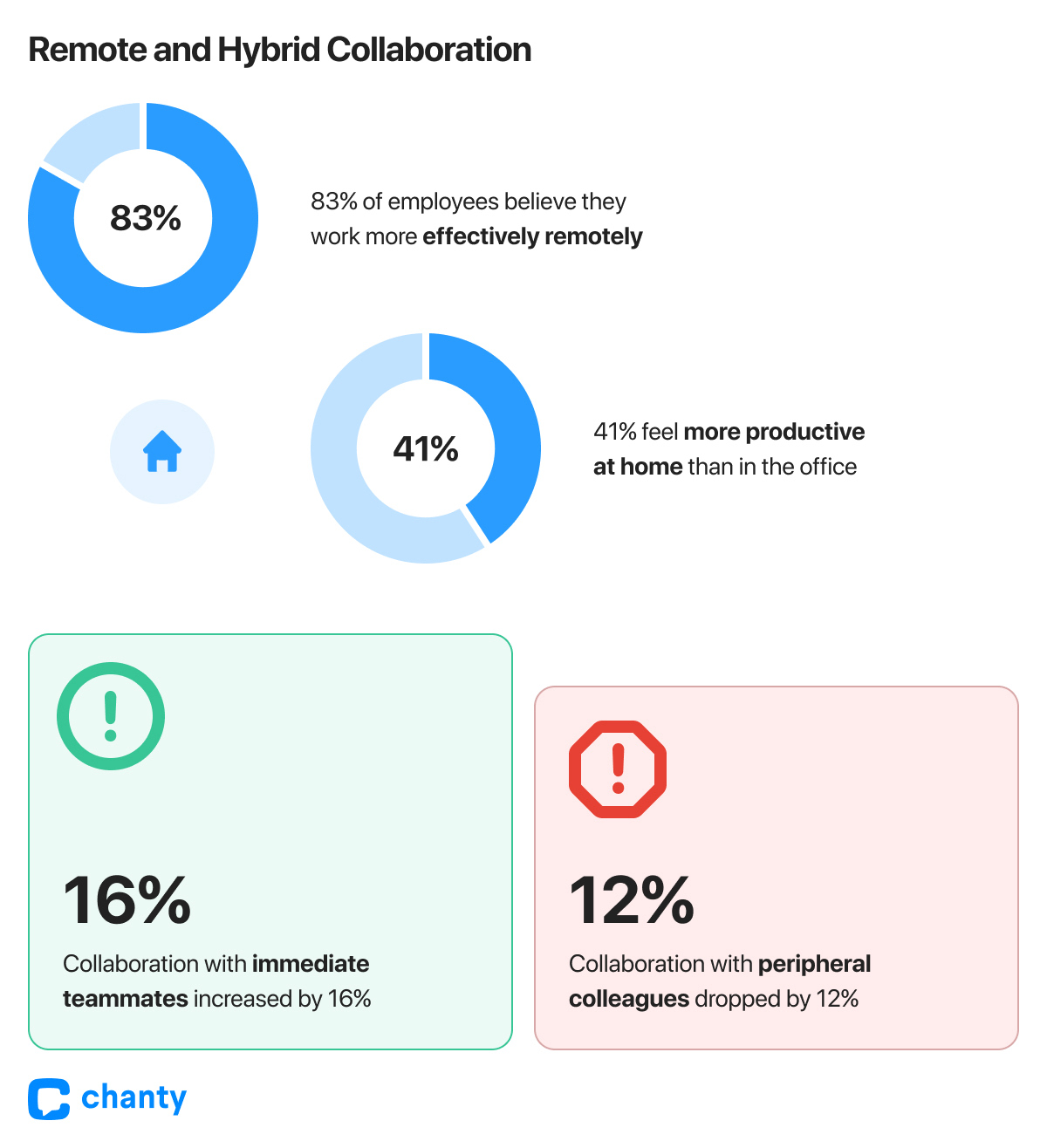
- 83% of employees believe they work more effectively remotely
- 41% feel more productive at home than in the office, according to McKinsey survey
- Collaboration with immediate teammates increased by 16%
- Collaboration with peripheral colleagues dropped by 12%
All of this creates a paradox: execution improves, but cross-functional collaboration weakens.
Peripheral connections – the ones outside immediate teams – are often where innovation emerges. Their decline raises long-term risks for creativity and organizational learning.
Hybrid work doesn’t eliminate collaboration; it reshapes who collaborates with whom.
AI in the next phase of teamwork
Artificial intelligence is now embedded in almost every part of work, from writing and planning to decision-making, and its influence is only expected to grow. In the context of collaboration in the workplace, AI can act as a quiet ally, helping teams avoid misunderstandings, smooth out cultural differences, and prevent delays before they happen.
Global teams often struggle not because people disagree, but because language, working styles, and cultural norms make even simple exchanges harder than they seem. Asking for clarification can feel awkward, while repeated explanations slowly drain momentum.
AI helps translate intent, clarify tone, and surface context in real time. Human collaboration does not disappear, but it changes shape – and the workplace collaboration statistics show exactly how these shifts impact efficiency and alignment.
What the data shows when AI is applied to collaboration
- Project speed and delivery
When feedback arrives late, work stalls. When it arrives in context, work moves.- Real-time AI feedback improves project turnaround times by up to 40%, largely by eliminating the invisible waiting that teams rarely track but constantly feel.
- Decisions happen closer to the moment of action, rather than circling through inboxes and calendars.
- Cross-cultural clarity
Most collaboration problems aren’t conflicts. There are misunderstandings that linger just long enough to slow everything down.- Unilever introduced AI systems that adjust language and tone for different cultural contexts.
- Result: 30% increase in projects completed on schedule
- The real win wasn’t speed, but fewer moments of “That’s not what I meant.”
- Siemens deployed AI tools that predict communication preferences and likely friction points before they turn into delays.
- Result: 25% reduction in delays caused by misunderstandings
- Less time untangling confusion, more time moving forward together.
- Unilever introduced AI systems that adjust language and tone for different cultural contexts.
- Reduced collaboration drag
Every team knows the feeling of waiting – for clarification, approval, or someone else’s context.
AI surfaces intent, history, and relevance automatically.- Waiting cycles shrink because fewer questions need to be asked at all.
- Work flows with fewer stops and fewer forced explanations.
How AI quietly changes collaboration mechanics
- Instead of adding another tool to check, AI embeds feedback where work already happens.
- Alignment becomes continuous, not something teams chase in meetings.
- Collaboration shifts from constant correction to quiet prevention.
A measurable shift in how teams collaborate
Research by Anthropic on Claude Code usage captures a subtle but important change in team behavior:
- Many users report that most of their questions now go to AI instead of colleagues.
- AI has become the first place people go to think out loud – to test ideas, clarify doubts, or sanity-check decisions.
- Some worry this means less human collaboration, or even working themselves out of a job.
In reality, it often means fewer interruptions and fewer “quick questions” that weren’t actually quick.
Collaboration tools: growth without maturity
As we began this article with Ancient Athens, it’s worth looking back again. There, the agora was the beating heart of civic life – and today’s collaboration tools are the modern equivalent: a digital agora where ideas meet, debates flare, and, occasionally, office gossip migrates into chat threads.
Over the last few years, these platforms have become the bustling marketplaces of professional thought: Slack channels hum like breakrooms full of whispers, shared boards buzz like meeting rooms cluttered with flipcharts, and notifications ping like cubicles arguing over whose stapler went missing.
Yet, like any crowded agora, too many voices can overwhelm the crowd, and without some order, even the brightest ideas can get lost in the shuffle.
The global collaboration tools market reflects this duality: it was valued at $18.2 billion in 2024 and is projected to grow from $39B in 2023 to $116B by 2033, signaling both opportunity and dependency. Organizations have invested in technology to connect people, but connection alone does not equal collaboration.
- Tool overload creates digital chaos: Employees juggling more than 10 apps report communication issues at a higher rate (54%) than those using fewer than five apps (34%) – it’s the online equivalent of trying to herd a dozen chatty philosophers into one debating circle.
- Efficiency gains require thoughtful use: 76% of employees using project management tools report improved efficiency – but sporadic adoption leaves projects bouncing between threads like post-it notes in a cluttered office.
- Partial adoption persists: Only 26% of employees rely on online chat as their main communication tool – leaving many messages lost in the digital equivalent of a messy inbox mountain.
- Pandemic-era adoption surges: Collaboration tool use jumped 44% since COVID-19, and today 90% of businesses employ some form of internal platform, creating a virtual office that’s always “on,” even if the coffee machine is turned off.
In short, collaboration tools are our modern agora: a lively, noisy, occasionally chaotic space where ideas can flourish – but only if guided wisely. Without clear norms, ownership, and workflow design, they amplify noise instead of clarity. Even in the most advanced digital offices, collaboration succeeds only when leadership shapes the space and sets the conversation in motion.
Why managers matter more than tools
In modern workplaces, collaboration succeeds or fails primarily at the managerial level, where leadership behavior directly shapes engagement, trust, and decision-making.
Tools may enable collaboration, but managers determine whether it actually works.
If collaboration is the bloodstream of a team, managers are the heart that keeps it moving. They set the pace, the tone, and the emotional safety that allows ideas to circulate instead of getting stuck. This matters even more in distributed and hybrid teams, where physical distance and asynchronous work can quietly turn capable professionals into isolated contributors.
When leadership is unclear or absent:
- People may still work, but collaboration weakens
- Ideas stop traveling
- Ownership fades
Measurable managerial impact
- 70% of the variance in employee engagement is explained by managers
- Teams with empowered decision-making are 3.9 times more likely to succeed
At the same time, the role of the manager has expanded far beyond traditional oversight. Today’s leaders are expected to:
- Motivate, mediate conflict, protect team moral
- Deliver results, and embody company values
- Navigating uncertainty while guiding teams
According to Gartner, around 75% of HR leaders report that managers feel overwhelmed by expanded responsibilities, particularly those related to collaboration, engagement, and people outcomes.
Despite this pressure, managers remain the clearest signal of organizational culture. Employees watch behavior more closely than they listen to strategy decks.
If a leader disengages, arrives late, or treats collaboration as optional, that message spreads quickly. In practice, managers become the living translation of company values, whether intentionally or not.
This growing strain helps explain why leader and manager development became the number one organizational priority in 2025. Deloitte research shows a broad consensus that the role of mid-level managers must be rethought, based on global and regional surveys:
- 73% of companies worldwide say the mid-level manager role needs fundamental redesign
- Nearly 79% of companies in Ukraine report the same, reflecting regional pressure from hybrid work, talent mobility, and operational stress
The shift is moving away from administrative control and toward talent development, decision enablement, and human leadership
Everyday manager actions that enable collaboration
Technology can support collaboration at scale, but it cannot sustain it on its own. Managers do that through everyday actions that either enable or quietly block teamwork:
- Clarifying ownership instead of diffusing responsibility
- Creating psychological safety instead of silent disengagement
- Supporting decisions instead of delaying them through endless alignment
This leadership effect is especially pronounced for younger employees, for whom collaboration is closely tied to identity and belonging:
- Nearly 40% of Gen Z and millennials say workplace culture strongly influences whether they stay
- Over 90% of Gen Z values authenticity at work, making performative leadership easy to detect and quick to reject
In today’s workplace, collaboration is no longer just a process or a soft skill. It is deeply connected to trust, inclusion, and the feeling of being seen. When managers remain steady under pressure and lead by example, teams feel safe enough to contribute. And when people feel safe, collaboration stops being forced. It becomes the natural way work gets done.
Workplace collaboration 2026: Trends, tips, and predictions
Why isn’t my teamwork working anymore?
Collaboration only shines when it’s intentional. Misalignment, unclear roles, and poor communication kill momentum. Fix it by clarifying priorities, defining responsibilities, and scheduling regular check-ins. Structure beats hope every time.
Who wins – teamwork or individual work?
Both! Teamwork sparks innovation and tackles complex problems, while individual work allows focus and deep expertise. Use each for the right task, or better yet, combine them – that’s the big win.
Do collaboration tools save the day?
They can, but only if chosen wisely. Test different tools, pick the ones that fit your workflow, and avoid overload. Need a jumpstart? Book a demo with Chanty and see how it can streamline your team’s work today.
Will AI replace human collaboration?
Nope. AI isn’t a teammate – it’s a helper. It handles repetitive tasks, organizes information, and saves time, leaving humans to focus on strategy, creativity, and real human connection. Treat AI as your ally, not your boss.
What about leadership in 2026?
Great leaders don’t just give instructions – they listen, guide, and model balance. Leadership isn’t about seminars or quick fixes; it’s about creating an environment where your team feels heard, supported, and motivated to do their best. Lead by example, not by checklist.
Collaboration is no longer a soft skill or cultural bonus. It’s a strategic system. Companies that treat it as such will outperform those that simply encourage people to “work together.”